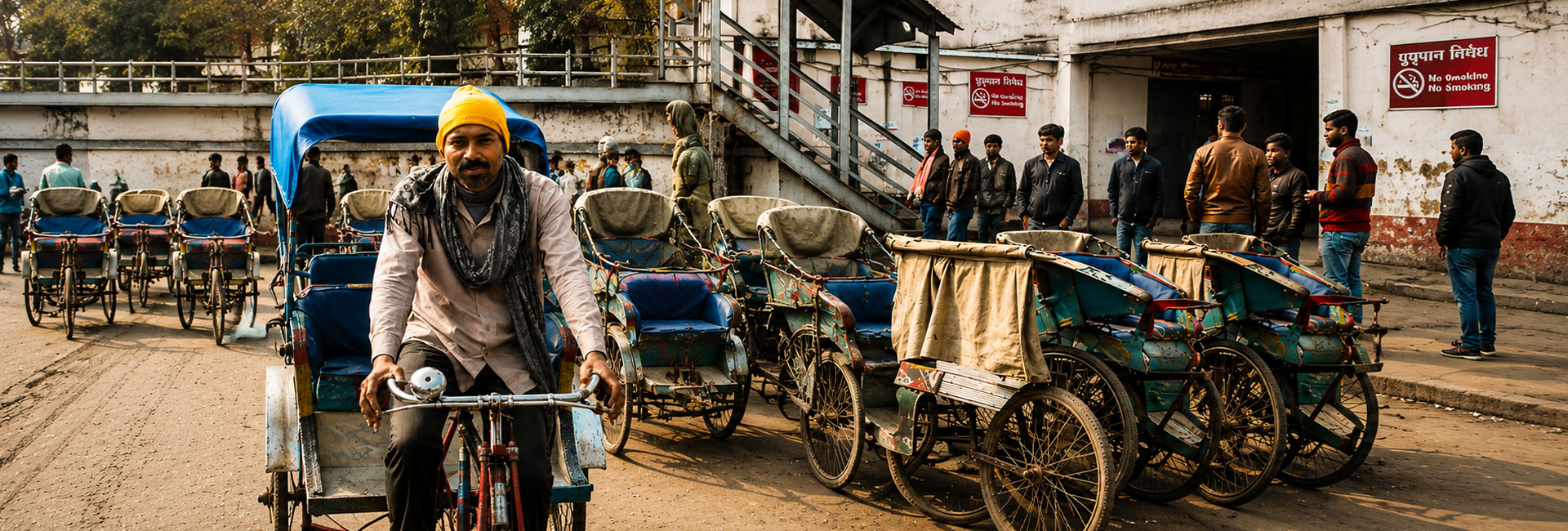


Rickshawpullers and Project Adhikar
Health, Identity and Dignity for Migrant Workers
Reaching more than 45,000 workers and their families
Recognising the People Behind Our Cities
India's cities depend on the labour of millions of migrant workers. They transport people, construct buildings, provide essential services and contribute to the everyday functioning of urban communities. Yet many live and work without adequate shelter, financial security, reliable healthcare or the documentation needed to access government services.
For migrant and informal-sector workers, these challenges are often interconnected. Uncertain incomes, frequent movement in search of employment, difficult living conditions and limited access to information can leave individuals and their families particularly vulnerable.
Maitri recognised that meaningful humanitarian support required more than addressing an immediate need. It meant understanding people's circumstances, earning their trust and helping them access the services and opportunities available to them.
Through Project Awaaz in Delhi and Project Adhikaar in Ranchi, Maitri worked closely with migrant workers, particularly rickshaw pullers, to improve access to healthcare, promote HIV prevention, facilitate identity documentation and strengthen connections with essential public services.
Together, these initiatives reached more than 45,000 workers and their families, reflecting Maitri's commitment to improving health, well-being and social inclusion among underserved urban communities.
Project Awaaz
Bringing Healthcare Within Reach
HIV Prevention, Counselling and Care | Delhi
Project Awaaz was established to address the health needs of migrant workers, particularly rickshaw pullers in Central Delhi, who often had limited access to reliable healthcare and information about HIV/AIDS and sexually transmitted infections (STIs).
Living away from their families, often in overcrowded or insecure accommodation, many workers faced considerable barriers to seeking medical attention. Long working hours, irregular incomes, social stigma and limited awareness of available services could make timely diagnosis and treatment difficult.
Maitri's approach was grounded in the understanding that healthcare must be accessible, confidential and free from judgment.
Rather than expecting workers to navigate an unfamiliar healthcare system on their own, Project Awaaz brought information, counselling and preventive services closer to the communities it served.
Through regular outreach, health camps, education sessions and community engagement, the programme helped workers better understand HIV transmission, prevention, testing and treatment.
Its interventions included:- HIV awareness and prevention: Providing accurate, practical information on HIV/AIDS, sexually transmitted infections and preventive healthcare.
- Counselling and testing: Facilitating access to HIV testing, counselling and early identification of infections through community-based outreach and healthcare linkages.
- Preventive services: Improving access to condoms through distribution and non-traditional outlets located within workers' communities.
- Treatment and continuing care: Connecting individuals requiring medical attention with appropriate health facilities, STI treatment services, antiretroviral therapy centres and other providers.
- Community engagement: Building trust through regular interaction, encouraging informed health decisions and addressing stigma and misconceptions surrounding HIV/AIDS.
An important aspect of Project Awaaz was its recognition that health concerns could not be separated from the broader circumstances in which workers lived. Maitri also assisted individuals in accessing identity documents, banking facilities and government welfare services, helping reduce some of the practical barriers that prevented them from obtaining essential support.
The strength of Project Awaaz lay in making healthcare more accessible while treating every individual with confidentiality, compassion and respect.
Project Adhikaar
Identity, Recognition and Access to Essential Services
Established in 2012 | Ranchi, Jharkhand
Building on its experience with migrant communities, Maitri launched Project Adhikaar in Ranchi in 2015 to address the social and economic challenges faced by approximately 12,000–15,000 rickshaw pullers.
For many workers in the informal economy, the absence of recognised identity or address documentation created difficulties extending far beyond administrative procedures.
Without appropriate documents, accessing a bank account, government welfare schemes, healthcare, social security benefits or other essential services could become an overwhelming challenge.
Project Adhikaar sought to bridge this gap by helping workers establish their identity, understand available entitlements and connect with formal institutions and public services.
Assisting workers with the processes required to obtain or update identity and address documents, enabling greater access to government services and social welfare programmes.
Facilitating connections with healthcare providers, sanitation services and relevant public institutions to address concerns affecting workers' health, safety and everyday well-being.
Supporting access to formal banking, financial services and government welfare schemes, while encouraging community participation and stronger links with civic institutions.
Beyond providing information and assistance, Project Adhikaar encouraged workers to organise, participate in community discussions and become more confident in approaching institutions that could address their needs.
For a worker who has spent years contributing to a city's economy, having recognised documentation and access to essential services can bring greater security, independence and peace of mind.
Project Adhikaar reflected Maitri's belief that every individual deserves to be acknowledged, valued and treated with dignity, irrespective of occupation, income or social circumstances.
A Lasting Contribution
The significance of these initiatives extended beyond the number of people reached.
Project Awaaz demonstrated the value of taking preventive healthcare directly to underserved communities, building relationships of trust and connecting people with appropriate medical services.
Project Adhikaar addressed another important dimension of vulnerability: the difficulties workers face when essential documentation and access to public services remain beyond their reach.
Together, the projects reflected a humanitarian approach that recognised the close relationship between health, economic security, identity and individual well-being.
For Maitri, this work was both an important achievement and a period of learning. Working alongside migrant communities deepened the organisation's understanding of how social exclusion affects everyday life and how consistent, practical support can help individuals and families navigate those challenges.
Although these programmes are no longer operational, their contribution remains an important part of Maitri's journey.
More than 45,000 workers and their families were reached through initiatives built on a simple conviction: that every person, regardless of occupation or circumstance, deserves access to care, opportunity and a life of dignity and respect.
Project Awaaz was recognised as the best targeted intervention programme for migrant workers in Delhi by the Government of India for two consecutive years.
Maitri's work with migrant communities was founded on the understanding that access to healthcare, legal identity and basic services is essential to a life of dignity. Through sustained community engagement, we helped bring these services within reach of thousands of workers and their families.
Unfortunately, the COVID-19 pandemic brought these programmes to an abrupt halt. With funding support from the government and donors significantly reduced, Maitri was reluctantly compelled to discontinue these impactful initiatives, despite their meaningful contribution to the lives of thousands of migrant workers and their families.